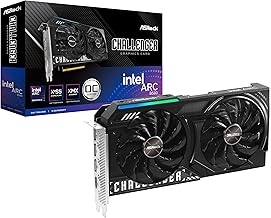
Navigating the mid-range graphics card market has become a thrilling challenge with the arrival of Intel's Arc series. Among the contenders, the Intel Arc B580 stands out as a compelling proposition for gamers seeking high frame rates without the flagship price tag. This review dives deep into the performance, architecture, and real-world value of this GPU, helping you decide if it's the right centerpiece for your next gaming rig or upgrade.
Architecture & Specifications: The Foundation of Performance
At its core, the Intel Arc B580 is built on the Xe-HPG architecture, a design focused on delivering efficient gaming performance. A key specification that immediately grabs attention is its generous 12GB of GDDR6 memory on a 192-bit bus. In today's gaming landscape, where titles like 'Alan Wake 2' and 'Cyberpunk 2077' with ray tracing can easily consume over 8GB of VRAM at 1440p, this buffer is a significant advantage. It provides ample headroom for high-resolution textures and future-proofs your system against increasingly demanding games.
The card features a robust number of Xe-Cores (or Execution Units) and ray tracing units, enabling it to handle modern visual effects. Intel's Deep Link technology, when paired with a compatible Intel CPU, can further boost performance in supported applications by leveraging the integrated and discrete graphics together. For builders looking at a balanced desktop graphics card, the spec sheet of the B580 suggests a strong focus on the sweet spot of 1080p and 1440p gaming.
Gaming Performance Benchmarks: The Real-World Test
Specifications are one thing, but frame rates are what matter on your screen. We tested the Sparkle Titan OC model, the SB580TW-12GOC, across a suite of popular games at 1080p and 1440p resolutions.
At 1080p with max settings, the B580 consistently delivers exceptional performance. In competitive titles like 'Fortnite' (DX12) and 'Apex Legends', expect well over 144 fps, perfectly matching high-refresh-rate monitors. For graphically intensive single-player games such as 'Horizon Zero Dawn' and 'Red Dead Redemption 2', it comfortably maintains averages above 80-90 fps, ensuring a smooth and immersive experience.
Stepping up to 1440p is where the 12GB frame buffer truly shines. In many titles, the performance drop from 1080p is minimal, often staying within a 20-25% range. Games like 'Elden Ring' and 'Forza Horizon 5' run beautifully at this resolution with high settings. While enabling full ray tracing can be demanding, the B580 handles lighter RT implementations or uses Intel's XeSS upscaling technology to maintain playable frame rates with enhanced visuals. This makes it a formidable gaming graphics card for the QHD market.
Cooling, Acoustics & Power Efficiency
The Sparkle Titan OC cooler on this particular model is a triple-fan design that does an admirable job. Under sustained gaming load, the GPU temperatures typically plateau in the mid-70s °C, which is excellent for both performance consistency and longevity. The fans remain relatively quiet, with a subdued hum that is easily drowned out by game audio or a decent pair of headphones.
Power efficiency is a strong suit for the Intel Arc B580 architecture. With a typical board power around 190W, it sits in a reasonable bracket, meaning you won't need to overhaul your power supply. A quality 550W-650W PSU is sufficient for most system configurations featuring this card, making it a viable PC gaming upgrade without excessive ancillary costs.
Value Proposition: B580 vs. The Competition
This is perhaps the most critical analysis for any budget gaming GPU. The B580's primary rivals are NVIDIA's GeForce RTX 4060 (8GB) and AMD's Radeon RX 7600 XT (often 12GB).
The B580 often trades blows with these cards in traditional rasterization performance. However, its 12GB of memory gives it a tangible edge in memory-intensive scenarios at 1440p, where the 8GB on some competitors can become a bottleneck. In terms of features, Intel's XeSS upscaling is now mature and supported in a wide range of games, offering image quality competitive with DLSS and FSR. While NVIDIA's ecosystem still holds an advantage in ray tracing performance and certain creator applications, the B580 presents a fantastic balance of price, performance, and future-proofing for the pure gamer.
Who Is the Intel Arc B580 For?
The ideal user for this graphics card is clear:
- The 1440p Gamer on a Budget: If you want to game at 1440p with high settings and don't want to worry about VRAM limitations for the next few years, the B580's 12GB is a major selling point.
- The High-Refresh-Rate 1080p Enthusiast: For buttery-smooth gameplay in esports and AAA titles at 1080p, this card is overkill in the best way, ensuring you max out your monitor's potential.
- The Smart Upgrader: If you're moving from an older GTX 1060, RTX 2060, or similar card, the B580 offers a massive generational leap in performance and features.
It may be less ideal for professionals who rely on CUDA-accelerated applications or gamers who prioritize absolute maximum ray tracing performance above all else.
Final Verdict: A Confident Contender
The Intel Arc B580 is not just another GPU; it's a statement that Intel is here to compete seriously in the gaming arena. Cards like the Sparkle Titan OC variant deliver on their promise: excellent 1080p and 1440p gaming performance, effective cooling, and the peace of mind that comes with 12GB of VRAM. While the driver and software ecosystem continues to evolve and improve, the current state is robust for most gamers.
For anyone building a new mid-range system or looking for a substantial upgrade, the Intel Arc B580 deserves a spot at the top of your shortlist. It successfully challenges the established duopoly by offering a uniquely balanced package of price, performance, and specs. In the crowded mid-range segment, it stands out as one of the most sensible and forward-thinking choices available today.