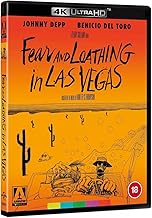
For over two decades, Terry Gilliam's cinematic adaptation of Fear and Loathing in Las Vegas has burned a neon-bright, hallucinogenic scar into the fabric of cult cinema. More than just a movie, it's a sensory assault, a philosophical treatise on the death of the American Dream, and a testament to the raw power of Gonzo Journalism. While modern formats like 4K UHD offer pristine clarity, there's a raw, authentic charm to owning the original Fear and Loathing in Las Vegas DVD. This guide is your roadmap to understanding why this particular release remains a cornerstone for collectors and a perfect portal into Raoul Duke's twisted universe.
The journey from page to screen was as chaotic as the narrative itself. Hunter S. Thompson's seminal 1971 book, a semi-fictionalized account of a drug-fueled trip to cover a motorcycle race, was long considered unfilmable. Its first-person, stream-of-consciousness prose and lack of a conventional plot defied Hollywood logic. Enter director Terry Gilliam, whose own visionary and anarchic sensibilities (honed with Monty Python) made him the only filmmaker brave—or crazy—enough to try. The result is a film that doesn't just adapt the book; it visually translates Thompson's Gonzo ethos, where the reporter becomes the central figure of the story, and objective truth is sacrificed for a higher, more subjective reality.
Why the Fear and Loathing DVD is a Cult Artifact
In the age of digital streaming, physical media like DVDs are often viewed as relics. However, for a film like Fear and Loathing in Las Vegas, the DVD release represents a specific moment in time and a curated experience. Early DVD editions were among the first to bring the film's kaleidoscopic visuals and immersive soundscape into the home with respectable quality. They served as the primary access point for a generation of fans who discovered the film outside of its initially tepid theatrical run. Owning the DVD became a badge of honor, a signal that you were in on the joke, part of the counter-cultural club that appreciated its abrasive genius.
The packaging and artwork of these DVD releases often embraced the film's psychedelic aesthetic. From the iconic screaming peyote button design to artwork featuring Ralph Steadman's splattered ink illustrations (which defined the book's visual language), the physical case itself is a piece of art. It stands in stark contrast to the sterile, algorithmically generated thumbnails of streaming services, offering a tactile connection to the film's rebellious spirit.
Depp and Del Toro: The Definitive Duke and Gonzo
The film's enduring power is inextricably linked to its two lead performances. Johnny Depp didn't just play Raoul Duke (Thompson's alias); he underwent a form of psychic osmosis, living in Thompson's basement, studying his mannerisms, and adopting his cadence. The result is one of the most committed and authentic performances of Depp's career. He captures Duke's paranoid grandeur, his poetic ramblings, and his tragic descent into a chemical haze with unnerving accuracy. It's a performance that goes beyond imitation to become embodiment.
Benicio Del Toro, as Dr. Gonzo, Duke's 300-pound Samoan attorney, is his perfect chaotic counterpart. Del Toro brings a volatile, childlike menace to the role, creating a character who is both terrifying and darkly hilarious. Their chemistry is the unstable engine of the film. Whether they are debating the nature of bats, terrorizing a waitress, or navigating the horrors of a psychedelic film convention, their dynamic is a masterclass in controlled chaos. The DVD allows viewers to revisit these legendary performances repeatedly, unpacking new layers of nuance in their interactions.
Gilliam's Vision: A Trip Through Cinematic Gonzo
Terry Gilliam's direction is the crucial alchemical element that transforms Thompson's words into a viable cinematic nightmare. He uses every tool in the filmmaker's kit to simulate a drug trip: fish-eye lenses, grotesque makeup, surreal set pieces, and disorienting editing. Scenes like the Bar sequence, where the patterns on the carpet come to reptilian life, are pure visual hallucinations realized on film. Gilliam doesn't ask the audience to watch a trip; he forces them to experience it.
This directorial bravura is perfectly preserved on the DVD format. The visual distortions and color saturation, essential to the film's effect, are presented with the intended impact. Watching it on a well-calibrated system, the garish neon of the Vegas strip and the sweaty, close-up terror on the actors' faces are powerfully conveyed. It's a reminder that Gilliam's work is not just storytelling but world-building, constructing a version of Las Vegas that exists purely as a psychological battleground.
Special Features: Mining the Gonzo Archive
One of the key values of the DVD movie release lies in its special features. Many editions include a treasure trove of supplementary material that deepens the appreciation for the film. These can include:
- Audio Commentary: Often featuring Terry Gilliam, Johnny Depp, and Benicio Del Toro, these tracks are famously entertaining and insightful, blurring the line between film analysis and Gonzo anecdote-sharing.
- Deleted Scenes & Extended Sequences: Given the film's tumultuous editing process, seeing what was left on the cutting room floor is fascinating for any fan.
- Featurettes: Documentaries on the making of the film, the challenges of adaptation, and Hunter S. Thompson's involvement (or fiery reactions) provide crucial context.
- Ralph Steadman Interviews: Insights from the legendary illustrator who gave Gonzo its visual identity are invaluable.
These features transform the DVD from a simple movie player into an educational package, offering a masterclass in adaptation, performance, and unconventional filmmaking. They solidify the release as the definitive edition for serious fans and students of cinema.
The Legacy and Cultural Impact of a Cult Classic
Upon its release in 1998, Fear and Loathing in Las Vegas was met with confusion and hostility from many mainstream critics. It was too loud, too abrasive, too nihilistic. Yet, this rejection by the establishment only fueled its ascent as a cult classic DVD. It found its audience through midnight screenings, word-of-mouth, and the burgeoning home video market. The film perfectly captured a certain fin-de-siècle anxiety and became a touchstone for a generation skeptical of authority and media narratives.
Its influence is vast. It cemented the popular image of Hunter S. Thompson and brought Gonzo journalism to a mass audience. Lines like "We can't stop here, this is bat country!" have entered the cultural lexicon. The film's aesthetic has influenced fashion, music videos, and countless other films. It remains a vital document of a certain strand of American madness, a hilarious and horrifying prophecy about excess and emptiness that feels more relevant with each passing year.
Fear and Loathing DVD vs. Modern Formats
While high-definition Blu-ray and 4K UHD releases offer sharper picture and lossless audio, the DVD holds its own unique place. For purists, the DVD's visual quality, with its slight grain and softer edges, can sometimes feel more aligned with the film's gritty, 1970s-inspired aesthetic. It has a texture that some argue is lost in ultra-clean digital remasters. Furthermore, the special features package on many DVD editions is often comprehensive and sometimes different from later releases.
Ultimately, collecting the Fear and Loathing in Las Vegas [DVD] is an act of preservation. It's about owning a piece of film history as it was first widely consumed. It represents the initial bridge between Thompson's literary masterpiece and its iconic cinematic counterpart. Whether you're a longtime fan revisiting the source of your obsession or a newcomer seeking an unfiltered entry point into Gonzo, this DVD is more than a disc; it's a ticket for a very specific, unforgettable trip to Las Vegas.
In conclusion, the power of Fear and Loathing in Las Vegas endures because it is more than a comedy or a drug film. It is a savage, surreal, and strangely poignant autopsy of the American Dream. The DVD release captures this spirit in a tangible form. From Depp's career-defining performance to Gilliam's unhinged direction and the wealth of contextual special features, it remains the essential physical artifact for anyone who has ever felt the call of the open road, the lure of the neon abyss, or the need to buy the ticket and take the ride.


![Fear and Loathing in Las Vegas (The Criterion Collection) [4K UHD]](https://m.media-amazon.com/images/I/815Dxqc0X7L._AC_UY218_.jpg)
![Fear and Loathing in Las Vegas [Blu-ray]](https://m.media-amazon.com/images/I/71kZZqdD57L._AC_UY218_.jpg)
![Fear and Loathing in Las Vegas (The Criterion Collection) [Blu-ray]](https://m.media-amazon.com/images/I/81h7QOrWU6L._AC_UY218_.jpg)