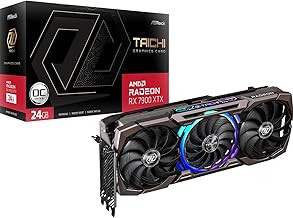
Navigating the high-end GPU market can be a daunting task, especially when faced with two powerful siblings from AMD's RDNA 3 lineup: the flagship 7900 XTX and its formidable counterpart, the RX 7900 XT. While the XTX often grabs headlines, the XT variant, exemplified by models like the ASRock AMD Radeon™ RX 7900 XT Phantom Gaming 20GB OC Graphics Card, presents a compelling alternative for discerning gamers and creators. This guide will dissect their differences, helping you determine which graphics powerhouse aligns with your performance demands and budget.
Architectural Foundations: RDNA 3 at the Core
Both the RX 7900 XTX and RX 7900 XT are built upon AMD's groundbreaking RDNA 3 architecture. This represents a significant leap forward, introducing a chiplet design similar to AMD's successful Ryzen CPUs. The key innovation is separating the Graphics Compute Die (GCD), which houses the core streaming processors, from the Memory Cache Dies (MCDs) that contain the Infinity Cache and memory controllers. This design improves manufacturing yield and allows for more efficient scaling of performance. Both GPUs support advanced features like hardware-accelerated ray tracing, AMD FidelityFX Super Resolution (FSR) upscaling technology, and the high-bandwidth PCI Express 4.0 interface, ensuring they are future-proofed for next-generation games and applications.
Specification Showdown: Where the Differences Lie
The primary distinction between the two models lies in their core configuration and memory subsystem. The RX 7900 XTX is the fully-enabled version, boasting 96 Compute Units (CUs), 6,144 stream processors, and a game clock that pushes higher frequencies. Its memory configuration is also more robust, featuring 24GB of GDDR6 memory on a wider 384-bit bus, coupled with 96MB of Infinity Cache. This combination delivers exceptional bandwidth, crucial for 4K and 8K gaming and high-resolution content creation.
In contrast, the RX 7900 XT, such as the Phantom Gaming model, is a slightly pared-back version. It features 84 CUs (5,376 stream processors) and comes with 20GB of GDDR6 memory on a 320-bit bus, paired with 80MB of Infinity Cache. While this is a step down on paper, the 20GB frame buffer is still immense and far exceeds the needs of virtually all current games at max settings, making it a high-end graphics card in its own right. The specific ASRock Phantom Gaming OC variant also brings factory overclocking and a premium cooling solution to the table, narrowing the real-world performance gap.
Gaming Performance: 4K and Beyond
In real-world gaming, the 7900 XTX consistently holds a performance advantage, typically in the range of 10-15% at 4K resolution with ray tracing enabled. It is designed to be the ultimate 4K gaming card, often achieving well over 60 fps in demanding titles with maxed-out settings. The RX 7900 XT, however, is no slouch. It delivers outstanding 4K performance, frequently hitting that coveted 60 fps benchmark. For gamers targeting high refresh rates at 1440p or smooth 4K gameplay with minor settings adjustments, the XT provides phenomenal value. Its substantial 20GB GDDR6 VRAM future-proofs it against games with increasingly large texture packs.
Ray Tracing and Upscaling
Both cards feature dedicated ray accelerators for real-time lighting effects. The XTX, with its greater compute resources, handles ray tracing workloads more comfortably. However, with the widespread adoption of AMD's FSR technology, which is supported on both GPUs, you can often enable ray tracing and use performance-boosting upscaling to maintain high frame rates on the 7900 XT as well. The choice here depends on how much priority you place on native rendering versus upscaled performance with enhanced visuals.
The Cooling and Acoustics Factor
This is where partner models like the ASRock Phantom Gaming shine. High-end GPUs generate significant heat, and cooling design is paramount. The Phantom Gaming 7900 XT employs a massive triple-fan heatsink, often with precision-machined heat pipes and a vapor chamber for efficient heat dissipation. A standout feature highlighted in its design is the 0dB Silent Cooling technology. This means the fans remain completely off during low-load scenarios like web browsing or light desktop work, resulting in a perfectly silent operation. When gaming commences, the fans spin up gradually, often maintaining lower noise levels than the reference cooler. When comparing the 7900 XTX to this specific XT model, the Phantom Gaming's cooling solution can sometimes offer a quieter or more thermally efficient experience than some reference XTX designs, adding a tangible quality-of-life benefit.
Connectivity and Display Outputs
Both generations are well-equipped for modern displays. A key advantage of RDNA 3 is the inclusion of DisplayPort 2.1 support, a feature where AMD currently leads. The ASRock Phantom Gaming 7900 XT offers 3 x DisplayPort™ 2.1 and 1 x HDMI™ 2.1 port. DisplayPort 2.1 offers immense bandwidth, supporting 8K resolution at 165Hz or 4K at 480Hz without compression. This makes either card, but particularly the Phantom Gaming graphics card, an excellent choice for users with high-refresh-rate 4K monitors or early adopters of 8K displays. The HDMI 2.1 port is perfect for connecting to the latest 4K/120Hz TVs for console-like gaming in the living room.
Price-to-Performance: The Ultimate Decider
The most critical differentiator is value. The RX 7900 XTX commands a premium for its top-tier performance. The RX 7900 XT, especially well-designed custom models, is frequently available at a noticeably lower price point. When you evaluate the performance per dollar, the 7900 XT often emerges as the smarter buy for most enthusiasts. You sacrifice a small percentage of peak performance for significant savings, which can be redirected towards a better CPU, more RAM, or higher-capacity storage. The ASRock Phantom Gaming model adds further value with its robust cooling, silent operation, and factory overclock, delivering a premium experience that closely challenges the XTX.
Who Should Choose the RX 7900 XTX?
The 7900 XTX is the undisputed choice for:
- Elite 4K Gamers: Users who demand absolute maximum frame rates at 4K with all settings, including ray tracing, turned to the highest possible level.
- 8K Pioneers: Those with an 8K display who need the extra memory bandwidth and compute power for next-resolution gaming.
- Professional Creators: Professionals in 3D rendering, video editing, and simulation where the extra CUDA cores and memory bandwidth can translate to faster render times.
- No-Compromise Enthusiasts: Buyers for whom budget is a secondary concern to owning the absolute best GPU in AMD's lineup.
Who is the RX 7900 XT Phantom Gaming Perfect For?
The RX 7900 XT Phantom Gaming is the ideal candidate for:
- Value-Conscious High-End Gamers: Players seeking exceptional 4K performance (60+ fps) without paying the flagship premium.
- High-Refresh-Rate 1440p Users: Gamers with 1440p monitors targeting 144Hz or higher, where this GPU will be consistently maxed out.
- Silent PC Builders: Enthusiasts who prioritize a quiet computing environment and value the silent cooling graphics feature during non-gaming tasks.
- Future-Proofed System Builders: The 20GB VRAM ensures this card will handle game textures and mods for years to come, making it a wise long-term investment.
- Those Who Prefer Premium Custom Designs: Buyers who appreciate the enhanced power delivery, cooling performance, and aesthetic of partner cards over reference models.
Final Verdict
The AMD Radeon RX 7900 XTX remains the performance king of the RDNA 3 family, offering unmatched power for the most demanding use cases. However, the RX 7900 XT, particularly in its premium custom implementations like the ASRock Phantom Gaming OC, presents an incredibly compelling proposition. It delivers 90-95% of the gaming performance of the XTX in many titles at a substantially lower cost, wrapped in a cooler and often quieter package. For the majority of gamers building a high-end system, the smart money and the best overall value lie with the RX 7900 XT. It provides a near-flagship experience that effortlessly powers through 4K gaming today while its ample resources keep it relevant for tomorrow's titles. Before deciding, assess your monitor's resolution and refresh rate, your budget, and how much you value absolute silence. Whichever you choose, both the 7900 XTX and the 7900 XT stand as titans of modern GPU performance.