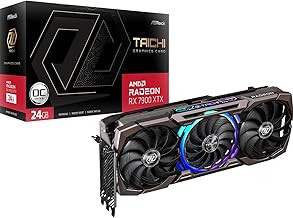
In the fiercely competitive arena of high-performance graphics cards, the ASRock RX 7900 XTX Taichi OC emerges as a formidable contender. Built around AMD's flagship RDNA 3 architecture, this card isn't just about raw power; it's a statement of engineering prowess aimed at enthusiasts and hardcore gamers who demand the absolute best for 4K gaming, content creation, and immersive ray-traced experiences. This review delves deep into what makes this particular AMD Radeon RX 7900 XTX model stand out in a crowded field.
Unboxing the ASRock Taichi: Premium Design Meets Cooling Innovation
Right out of the box, the ASRock Taichi commands attention. Its massive triple-fan cooler, adorned with the signature Taichi gear motif and ARGB lighting, exudes a premium, industrial aesthetic. The card's substantial heft is a testament to its robust cooling solution, which we'll explore in detail. This isn't just a graphics card; it's a centerpiece for any high-end build. The build quality is exceptional, featuring a metal backplate that not only adds rigidity but also aids in heat dissipation. For builders looking for top-tier PC gaming hardware, the Taichi's presentation sets a high bar.
Core Specifications & RDNA 3 Architecture Deep Dive
At its heart, the ASRock Taichi leverages the full potential of the Navi 31 GPU. With 96 Compute Units, 6144 stream processors, and a game clock speed that pushes beyond the reference design thanks to its factory overclocked status, this card is built for performance. The star of the show is its massive 24GB of high-speed GDDR6 memory on a wide 384-bit bus. This 24GB GDDR6 frame buffer is a critical asset for modern gaming, especially at 4K resolution with maxed-out textures and for future-proofing against increasingly demanding titles. The RDNA 3 architecture introduces a chiplet design, improved ray accelerators, and enhanced AI acceleration, all of which the Taichi utilizes to deliver exceptional efficiency and performance per watt.
Gaming Performance Benchmarks: Conquering 4K and Beyond
We put the 7900XTX Taichi through its paces across a suite of demanding games at 4K resolution. In rasterized performance, the card is an absolute powerhouse. Titles like Cyberpunk 2077 (without Ray Tracing), Microsoft Flight Simulator, and Red Dead Redemption 2 consistently delivered frame rates well above 60 FPS at Ultra settings, often pushing into the 90-100+ FPS range in less demanding scenes. This level of performance solidifies its position as a premier 4K gaming graphics card. When compared to its main competitor, the NVIDIA GeForce RTX 4080, the Taichi often holds a slight lead in traditional rasterization, making it a compelling choice for gamers who prioritize pure frame rates.
Ray Tracing & Upscaling: How Does the 7900 XTX Taichi Fare?
Ray tracing is where the narrative becomes more nuanced. AMD's RDNA 3 architecture has made significant strides, and the Taichi's dedicated ray accelerators handle the load admirably. In games like F1 22 or Fortnite with RT enabled, the experience is smooth and visually stunning. However, in path-traced titles like Cyberpunk 2077: Phantom Liberty with RT Overdrive, the performance hit is substantial, requiring the use of upscaling to maintain playable frame rates. This is where FidelityFX Super Resolution (FSR) comes in. FSR 2 and the newer FSR 3 with Frame Generation are game-changers, offering massive performance boosts with good image quality. The Taichi, as a capable ray tracing GPU, delivers a fantastic RT experience when paired with smart use of FSR.
Thermals, Acoustics, and Power Efficiency
The Taichi's cooling system, dubbed the "Striped Ring Fan" design, is exceptionally effective. Even under sustained full load in stress tests and during lengthy 4K gaming sessions, the GPU junction temperature remained impressively controlled, typically in the low 80s °C range. The fans, while audible under load, produce a relatively low-pitched hum rather than a whine, making them less intrusive. The card's power draw aligns with expectations for a high-end gaming GPU of this caliber, peaking around 400-420 watts. A quality 850W power supply is the minimum recommendation for a system built around this powerhouse.
Overclocking Headroom & Software Suite
Given that the Taichi arrives with a healthy factory overclock, one might wonder about additional headroom. Using ASRock's own Tweak software or AMD's Adrenalin Edition, we found modest but consistent gains. By carefully increasing power limits and adjusting fan curves, stable clock speed increases of 50-75 MHz on the core were achievable, translating to a few extra percentage points of performance. This appeals to the enthusiast who wants to squeeze out every last drop of performance from their ASRock Taichi graphics card. The software ecosystem from AMD is robust, with features like Radeon Anti-Lag, Chill, and an excellent recording/streaming suite adding tremendous value.
Verdict: Who Should Buy the ASRock RX 7900 XTX Taichi OC?
The ASRock RX 7900 XTX Taichi OC is not for the faint of heart or the budget-conscious. It is a premium product with a price tag to match. However, for the discerning gamer or creator who demands:
- Uncompromising 4K Performance: It is one of the fastest cards on the market for native 4K gaming.
- Future-Proofing: The 24GB VRAM buffer is a significant advantage for upcoming games and creative workloads.
- Premium Build & Cooling: Its design, aesthetics, and thermal performance are top-notch.
- An AMD-Centric Ecosystem: For users invested in FreeSync monitors and who appreciate AMD's driver software.
This card represents an excellent choice. While its ray tracing performance, though greatly improved, still trails the best from NVIDIA in the most extreme scenarios, its rasterization dominance, generous VRAM, and the effectiveness of FSR make it a incredibly well-rounded flagship. If your goal is to build a no-compromise gaming rig that will handle the next generation of games at maximum settings, the ASRock Taichi variant of the 7900 XTX deserves a spot at the very top of your shortlist.


